Landscape design and installation costs what it does because most of the price is labor, equipment, site prep and design time, not just plants and stone. In Utah, rocky or clay soil, slopes, tight access and hard freezes add work. To compare quotes fairly, line up scope, materials, prep and warranty, not the bottom number.
Why does landscape design and installation cost what it does?
Most homeowners picture the cost as a pile of materials: sod, pavers, shrubs, a fire pit kit. In practice the materials are often the smaller share. The rest is people and machines: the crew that grades the yard, sets the base, builds the walls, runs the irrigation and lighting, and cleans up afterward.
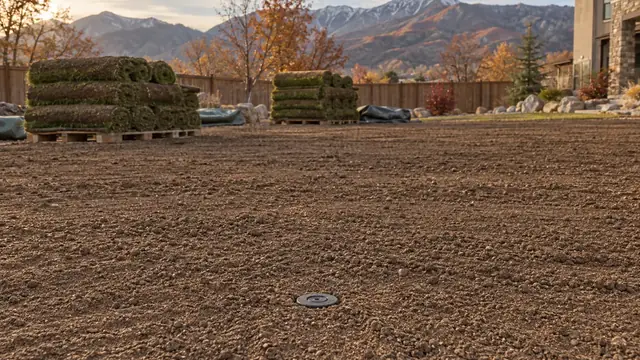
A finished yard is also several trades layered in the right order. Grading and drainage come first, then irrigation and any lighting conduit, then hardscape, then plantings and sod. Each layer has to be done properly before the next goes on top of it, because fixing a buried mistake means digging up finished work.
That is why a design-build project can look expensive next to a single product price. You are paying for a sequence of skilled work, not an item off a shelf.
What do you pay for in a design-build project besides plants and materials?
A few things sit behind the number that rarely show up as line items:
- Design time. Our design happens on site with a laser and marking paint, not in a brochure. Every estimate is an in-person walk-through, and that walk is where we find out what the yard actually needs.
- Equipment and crews. Specialized equipment makes jobs faster and cleaner, but it has to be owned, maintained and run by experienced people.
- Scheduling. A real schedule means a start date you can plan around. That takes overhead a one-truck operation does not carry.
- Warranty. Every installation we do carries a one-year warranty on our labor, plus Rain Bird’s warranty on irrigation parts.
None of this is unique to us. Any company doing design-build work properly is paying for some version of it. When a quote is far lower, it is worth asking which of these pieces is missing.
How do Utah soil, slope and site access change the price?
This is where two yards of the same size end up with very different quotes.
Soil
Rocky or heavy clay soil is slow to dig, slow to amend and hard on equipment. Soil that drains poorly may need grading or drainage work before anything else goes in. Skipping that step is a common reason new lawns and patios settle or pool water a year later.
Slope
Many northern Utah yards, especially in foothill and canyon-edge towns, are not flat. Sloped ground can mean retaining walls, stepped walkways, drainage routing and more careful grading. All of that is labor and base material before the visible part of the project even starts.
Access
If a truck cannot reach the backyard, material gets moved by hand or by small machines, and that takes far longer. It is one of the things we try to say early, because it changes the price and the schedule. Narrow side gates, steep driveways and finished landscaping in the way all count.
Winter
Frozen ground stops most excavation and installation work for part of the year, so a lot of projects get compressed into spring and summer. That is a scheduling reality, not a reason the work is overpriced.
Which choices make a project cost more or less?
Some of the price is set by your yard. The rest is set by your choices. This table shows the main factors and what to ask about each.
| Cost factor | What changes | Why it moves the price | Question to ask |
|---|---|---|---|
| Site access | Equipment reach | Hand work takes longer | Can machines reach the work area? |
| Slope and drainage | Grading, walls, routing | More labor and base material | How is water being handled? |
| Soil condition | Digging, amending, base | Slower work, extra prep | What prep is included? |
| Hardscape vs. softscape | Stone, pavers, concrete | Hardscape is labor and material heavy | What base and thickness are specified? |
| Lighting and irrigation | Trenching, wiring, zones | Extra trades and parts | Are existing lines protected? |
| Size and complexity | Square footage, features | More crew days | What can be phased? |
The takeaway: hardscape, slope work and anything that needs extra trades usually moves the price more than plant choices do, so that is where to look first when you want to adjust a budget.
How do you compare two landscaping quotes that look different?
A lower number is not a smaller price for the same job. It is often a different job. Put the quotes side by side and check:
- Scope, line by line. Does each quote cover the same square footage, features and cleanup? A vague one-line total hides what is left out.
- Prep and base. For patios and walkways, ask what depth of base is planned. For lawns, ask about grading and soil prep.
- Materials. Look for brand, grade or type, not just “pavers” or “shrubs.”
- Utilities and irrigation. Ask how existing sprinkler lines will be handled, and whether utility locates are planned before digging (in Utah, that means calling 811).
- Warranty in writing. Ask what is covered, for how long, and whether it covers labor or only parts.
- Schedule. A start date you can trust matters if the project has to finish before an event or the season.
We are rarely the cheapest bid, and we say so. What we will do is change the scope to fit a budget. We do not cut the price and then cut the work, and that is a fair test to apply to any contractor: if the price dropped, ask what changed in the plan.
What can you do to fit a design to your budget without cutting corners?
Cutting corners means thinner base, skipped drainage or smaller plants crammed in to look full. Adjusting scope is different, and it is usually where the savings are.
- Phase the project. Do grading, drainage and irrigation first, since they are hard to redo later. Add the patio, lighting or planting beds in a later season.
- Simplify the footprint. A smaller patio built right beats a larger one built thin.
- Pick one feature to splurge on. A fire pit or a good walkway often matters more than five average features.
- Decide your must-haves before the estimate. It makes the conversation faster and the quote cleaner.
- Ask about the rendering. A detailed rendering takes real design time, and sometimes it costs more than the budget justifies. It is better to hear that up front than after the fact.
If you want to see how this plays out for your yard, our landscape design and install page covers what we build, from patios and walkways to grading, drainage, lighting and plantings. When you are ready to talk numbers, you can reach out through our contact page and we will set up a walk-through.
Frequently asked questions
Is a landscape design worth paying for before installation?
Usually yes, because a plan settles drainage, access, layout and phasing before anyone digs. Changes on paper or marked out on site cost far less than changes after the base is set. How detailed the design needs to be depends on the project, and a simple yard may only need an on-site layout.
Why do two landscaping quotes differ so much?
Quotes often cover different scopes, base depths, materials and levels of prep, even when the project name is the same. Cleanup, warranty and who does the work also vary. Compare them line by line and ask what was left out of the lower one.
Can a project be done in phases to spread out the cost?
Often, yes. The usual approach is to do the hard-to-redo work first, such as grading, drainage and irrigation, then add hardscape, lighting or plantings later. Tell the contractor you plan to phase it so the first stage is built to accommodate the rest.
Does a rendering cost extra?
A detailed rendering takes design time, so it can cost extra, and on a smaller project it can cost more than the budget makes sense for. Ask at the estimate whether one is needed and what it would add. We try to say that early rather than surprise anyone.
Is it cheaper to book in winter for spring work?
Not automatically. Winter is the planning window, which gives you time to settle the design, scope and schedule before the ground thaws. The price depends on the work itself, so ask any contractor directly whether timing changes their quote.

Renegade Landscapes has designed, built and irrigated yards in Morgan, Weber and Davis counties since 2007. Utah S330 licence #11787969-5501, insured. About us